
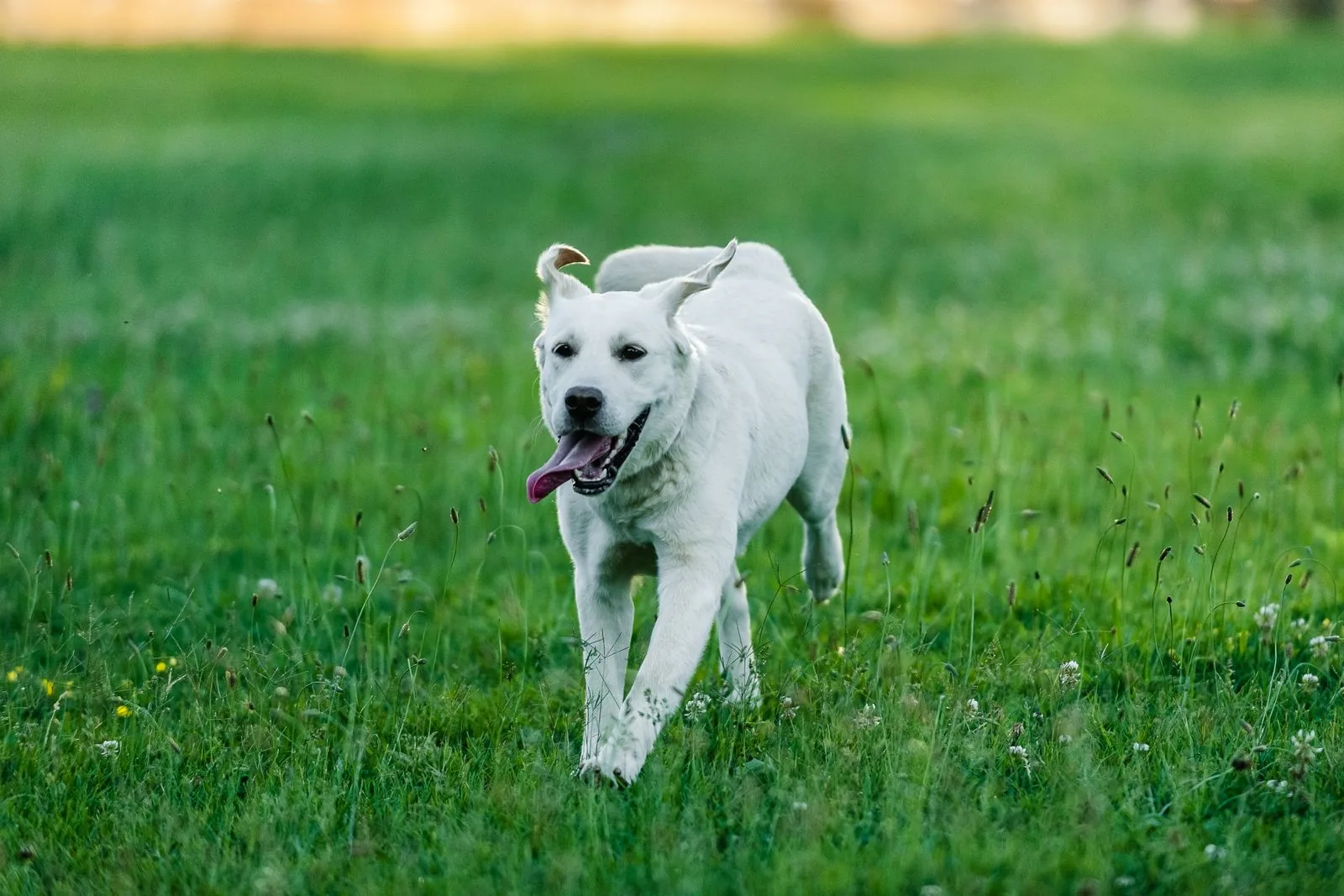
Best Joint Supplements for Dogs
Best Joint Supplements for Dogs in 2026, Graded by Veterinarians
The ingredients have to work in trials, at the dose on the label.
This ranking applies one rule: the ingredients have to work in trials, at the dose on the label. Applied honestly, that rule does not reproduce the market. Glucosamine and chondroitin are the category standard and carry the weakest canine file on this page: an independent 2017 review of the dog literature found the evidence limited and conflicting, and noted a paucity of well-designed veterinary studies on the question (Bhathal et al., 2017); the 2022 meta-analysis of 72 canine and feline trials then found no effect in 8 of the 9 trials in its glucosamine-chondroitin category (Barbeau-Grégoire et al., 2022).
The ingredients that come out ahead are the ones with randomized canine trials behind them. Undenatured type II collagen (UC-II®) has been reviewed independently twice, in 2020 and in a 2023 scoping review of 26 records (Gencoglu et al., 2020; Zapata & Fernández-Parra, 2023), and it has been tested against NSAID comparators rather than only against nothing. Marine EPA and DHA have randomized trials measuring force-plate weight bearing (Roush et al., 2010) and a placebo-controlled supplement trial in 78 dogs (Mehler et al., 2016). No single review carries the argument here, and where the reviews disagree with each other the page says so.
The ownership behind this page is disclosed in full at the foot of it: Pet Evidence Media is owned by Jope Inc., and the formula ranked first is Jope's own. The grading criteria are published in full so the order can be checked against them, or argued with.
One thing worth explaining up front. The order below is not glucosamine-versus-everything, it is a gradient. At the top are formulas built on ingredients with randomized trials in dogs. In the middle sit products built on eggshell membrane, which is genuinely promising but less studied than UC-II®. At the bottom are formulas still led by glucosamine and chondroitin, ranked among themselves by whether the company did any research and whether it doses honestly.
How the grade works (30-second version)
| Criterion | What it measures |
|---|---|
| Ingredient evidence | Quality and quantity of clinical trials in dogs, per active |
| Dose honesty | Does the daily dose match what the trials used? |
| Formula transparency | Full disclosure of actives, fillers, and sourcing |
| Third-party testing | Independent lab verification (COA) |
| Value | Cost per day at an effective dose |
| Inactive ingredient quality | Flavourings, preservatives, carriers and fillers, against a five-point checklist |
Full criteria and weights on the Methodology page. Scores are out of 10 and apply to the formula as sold, not the brand.
The ranking
Ingredient tags carry a thumb:
- Blue where the trial record supports the ingredient at the dose in this product.
- Red where the evidence points the other way, or the dose is too low to have produced a trial result.
- Unmarked where the evidence is thin, or where the tag isn't an active ingredient.
Every product below also carries an Amazon link. Those are affiliate links: Pet Evidence Media earns a commission on purchases made through them, on the competitors as much as on the Jope product. Commission does not set the order. The criteria above do.
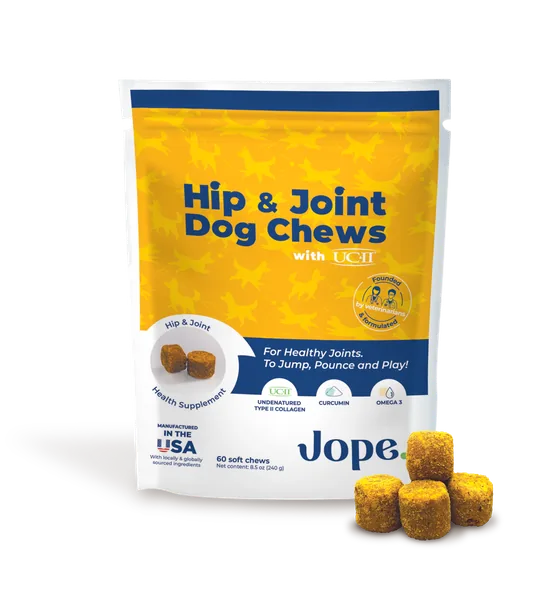
Jope is a recent brand with a single joint product, formulated from the current canine trial record rather than from the recipe this category inherited: undenatured type II collagen, marine Omega-3s and curcumin, and no glucosamine at all.
What the evidence supports
- UC-II®, an undenatured type II collagen with the deepest canine file of any active on this page: 10 or more studies in dogs, including randomized trials with objective outcome measures such as force-plate gait analysis.
- In a 150-day controlled study, owner-assessed pain and mobility improved 81% on UC-II® against 51% on glucosamine-chondroitin, a relative advantage of about 59% (Gupta et al., 2012).
- In that same study, objective ground-force-plate measures improved in the UC-II® group only: peak vertical force and impulse area.
- EPA and DHA from anchovy at 98 mg per chew (59 mg EPA, 39 mg DHA). This is the ingredient category with the most consistent canine evidence: randomized trials show improved force-plate weight bearing (Roush et al., 2010), a dose-dependent response (Fritsch et al., 2010) and improvement against placebo at 69 mg EPA plus DHA per kg per day (Mehler et al., 2016). 98 mg is the highest EPA-plus-DHA figure on this page, and the only one itemised by fatty acid rather than pooled with others, but it is still well below the daily target published for dogs with osteoarthritis. No soft chew can hold that volume of oil, this one included, and the real numbers sit in the Omega-3 dosing guide.
- A concentrated curcumin extract at 50 mg per chew for antioxidant support.
- Six of its ten inactive ingredients are certified organic, and it is preserved with mixed tocopherols alone. It is the only formula on this page that passes all five excipient checks.
Where it falls short
- No trial has been run on the finished chew. The case above is an ingredient case, assembled from trials of UC-II®, Omega-3s and curcumin run by other people on other products. That is the same gap held against #5 below, and it applies here.
- Value for multi-dog households. At a clinically aligned dose it costs more per day than legacy formulas. Where budget is the binding constraint, a well-dosed plain Omega-3 oil is the honest runner-up strategy.
- Third-party tested
- US-made
- 90-day money-back guarantee on petjope.com
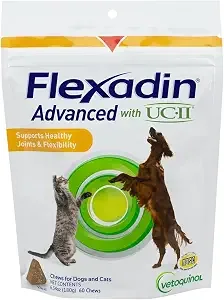
The formula closest to the top of this ranking on ingredient choice.
What the evidence supports
- It is built on UC-II®, a proven ingredient in dogs, and the same active that leads the formula ranked first. The canine record behind it is the strongest on this page: a randomized, double-blind, placebo-controlled crossover trial (Stabile et al., 2024) and two randomized trials in which it matched an NSAID comparator, robenacoxib (Stabile et al., 2019) and cimicoxib (Stabile et al., 2022).
- Some of that published work was done on this product, including a 110-dog, six-month multicentre study in dogs with degenerative joint disease (Cabezas et al., 2022). Testing the finished formula rather than only the raw material is rare in this category, and it is why the score sits at 8.4 rather than lower.
Where it falls short
- 23 inactive ingredients on Vetoquinol's own label, against ten in the formula ranked first. Inside that list: two synthetic preservatives (propionic acid and sorbic acid), an unnamed "vegetable oil", and maltodextrin as a filler.
- The Omega-3 is present but low. The 60-chew label lists Omega-3 fatty acids at 100 mg per chew from flaxseed and fish oil, of which EPA is 11 mg and DHA is given no figure at all. Flaxseed oil supplies ALA rather than EPA or DHA, so 11 mg is the part of that 100 mg the Omega-3 trials would count: roughly a ninth of the EPA-plus-DHA in the formula ranked first, and far below the doses those trials used. Vetoquinol's current 30-count label drops the Omega-3 line from its actives altogether and lists fish oil and flaxseed oil among the inactives, so even the 11 mg is not guaranteed across every pack size.
- The product-level study has no control group. It followed 110 dogs for six months and reported improvement from baseline, which cannot separate the supplement from time, owner expectation or placebo. The controlled UC-II® evidence is ingredient-level; the Flexadin-specific evidence is not controlled.
- A shorter ingredient story overall: a solid single-mechanism product rather than a complete one.
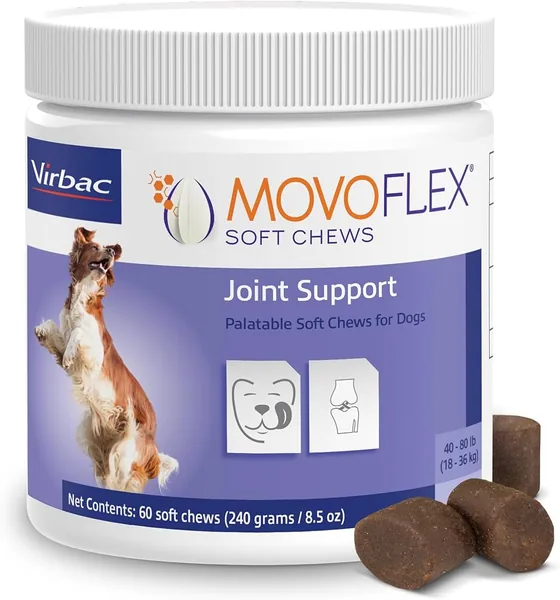
The most interesting formula on this page that Jope had no hand in. Two tenths of a point behind #2, and below it because UC-II®'s evidence base in dogs is deeper than eggshell membrane's, not because anything here is wrong.
What the evidence supports
- It drops glucosamine and chondroitin entirely. Virbac positions eggshell membrane as the replacement rather than an addition, so the formula is not built on the pairing the 2022 meta-analysis rejected. That single decision puts it above every glucosamine-led product below.
- Eggshell membrane has a randomized, double-blind, placebo-controlled trial in dogs. 51 dogs across eight veterinary clinics, 13.5 mg/kg once daily for six weeks: significant improvement in joint pain and function from week one, sustained at six weeks (Ruff et al., 2016).
- Eggshell membrane is a whole matrix rather than an isolated molecule: collagen plus naturally occurring glycosaminoglycans and glycoproteins, which is a plausible mechanistic answer to the bioavailability problem that sinks isolated glucosamine.
- Supporting actives with a rationale of their own: Boswellia serrata and astaxanthin, plus krill oil in the Advanced version.
Where it falls short
- Promising is not settled. Eggshell membrane rests on roughly one good canine RCT; UC-II® has 10 or more studies and has been tested head-to-head against glucosamine-chondroitin. Fewer trials pointing the right way still beats many trials pointing the wrong way, but it is not the same thing as a deep evidence base.
- No EPA or DHA figure is published anywhere. The standard chew carries no Omega-3 source at all. The Advanced version adds krill oil at 114 mg per chew, but Virbac states no EPA or DHA amount for it, on the label, on its consumer site or on its veterinary site, so the Omega-3 this formula delivers cannot be checked against the trial doses. On the dose-honesty criterion, an unverifiable dose is graded as if the ingredient were absent.
- Hyaluronic acid is on the label without a canine trial record behind it. A search of the dog literature returns no randomized trial showing that oral hyaluronic acid improves how a dog moves or feels. The closest study, 55 dogs after cruciate surgery, was randomized and placebo-controlled but measured joint-fluid biomarkers rather than mobility (Serra Aguado et al., 2021), and the one canine trial of a glucosamine-chondroitin-hyaluronic acid combination found no difference in overall scores (Alves et al., 2017). Injected hyaluronic acid is a different route with its own literature, and is not what is in this chew.
- The 2022 meta-analysis isn't a clean read on eggshell membrane either way: it pooled the ingredient into a broad collagen category alongside very different products, and its literature search closed in October 2021. That limitation is flagged in the decrypt too.
- Preserved with sodium benzoate and potassium sorbate, among eleven inactive ingredients, which puts it one item past the ten-item check in the table below. Worth knowing too: the Advanced version is the weaker of the two on excipients, adding artificial flavours, dextrose and molasses. The score above applies to the standard chew.
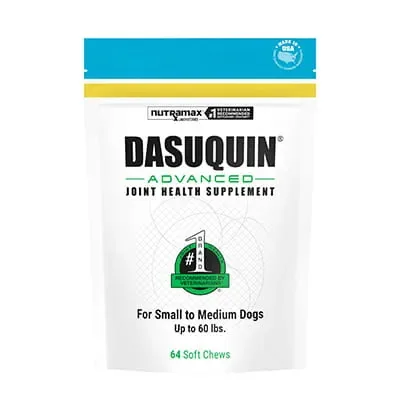
The right ingredient added to the wrong foundation, in a version most owners cannot actually buy.
What the evidence supports
- Adding eggshell membrane is a genuine upgrade over plain glucosamine-chondroitin. It is the one active in this formula that pairs a positive randomized, placebo-controlled canine trial with a dose in the range that trial used.
- And it is dosed, not dusted. The label states the eggshell membrane: 175 mg per small-to-medium chew, 335 mg per large one. Run that against the 13.5 mg/kg used in the trial and the loading dose lands on target at the top of each weight band, roughly 13 mg/kg for a 29 lb dog on one chew and for a 59 lb dog on two. Of the products here that carry a trial-backed ingredient, this is the one whose label lets an owner check the arithmetic.
- Nutramax has funded and published clinical work on its own formulas, which most brands in this category have never done at all. That is the clearest reason it sits above #5 rather than below it.
- ASU (avocado-soybean unsaponifiables, NMX1000®) has supportive data of its own.
- Manufacturing quality, batch control and veterinary-channel trust are genuinely high.
Where it falls short
- The formula is still led by glucosamine and chondroitin. The patented FCHG49® and TRH122® combination is the headline on the label, and that is the pairing 8 of the 9 trials in the 2022 meta-analysis's glucosamine-chondroitin category found ineffective, on top of a 2017 review that found the canine evidence limited and conflicting. Eggshell membrane arrives as an addition on top, not as a replacement.
- The clinical work is old, and its design would not clear today's bar. The canine trial usually cited dates from 2006: 35 dogs, glucosamine-chondroitin against carprofen as a positive control, with no placebo arm and outcomes scored subjectively by the attending vets (McCarthy et al., 2006). A trial designed now would be expected to carry a placebo group and an objective measure such as force-plate analysis or accelerometry, and no canine placebo-controlled trial of this formula has been published in the twenty years since. The most recent Nutramax canine work in the literature is cell culture rather than clinical (Grzanna et al., 2018). When the product was put through a modern placebo-controlled design, in cats rather than dogs, it did not separate from placebo: 59 cats, accelerometry plus validated owner measures, with the placebo group improving more on one of them (Cunningham et al., 2021). That is the wrong species to settle the dog question, and it is also the only modern controlled test of this formula on record.
- The maintenance dose halves the ingredient that earns it its place. After the initial 4 to 6 weeks the label moves to half the chews, which takes the eggshell membrane to roughly 6 to 7 mg/kg for most dogs, against 13.5 mg/kg in the trial. The dose that matches the evidence is the one owners are told to stop.
- The version graded here is sold through veterinary clinics only. Nutramax does not list Dasuquin Advanced with ESM through retail channels, and in clinic it typically costs more than the retail Dasuquin line. So the one ingredient that earns this formula its place is also the part that cannot be bought in a shop.
- The retail version has no eggshell membrane in it. What can actually be ordered is Dasuquin, or Dasuquin with MSM: glucosamine, chondroitin, ASU and MSM, with the ESM left out. Graded on its own, that formula loses the one active here that is both trial-backed and properly dosed, and sits below this card's score, not at it.
- The Omega-3 is a combined figure with no breakdown. This version does carry some: 65 mg per small-to-medium chew and 85 mg per large one, but stated as EPA, DHA and ETA added together, so the EPA and DHA a dog actually receives is some unstated fraction of that and cannot be compared with the trial doses. The retail Dasuquin and Dasuquin with MSM carry no Omega-3 at all; Nutramax sells that as a separate product.
- Eleven inactive ingredients, one past the ten-item check in the table below, and they include "natural and artificial flavors", an unnamed "vegetable oil" and an unspecified "starch". Credit where due: it is preserved naturally, with mixed tocopherols and rosemary extract, and carries no added sugar.
Heads up: this link goes to Dasuquin with MSM, the retail formula, because Dasuquin Advanced with ESM is not sold online. It does not contain eggshell membrane.
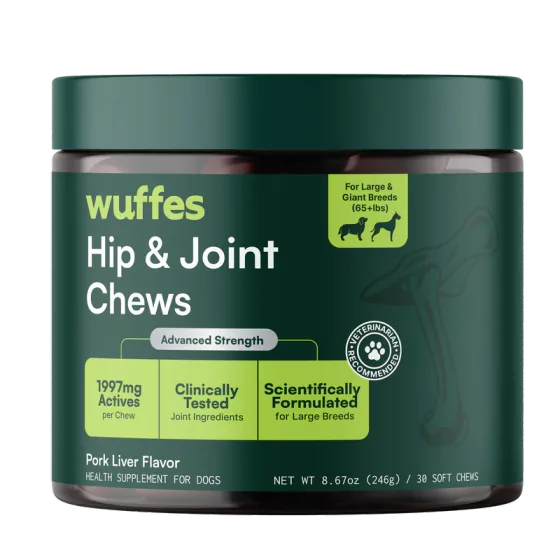
An honest dose of the wrong thing. Figures above are per chew, large-breed formula.
What the evidence supports
- It does not fairy-dust its lead ingredient. At 1250 mg of glucosamine HCl per chew for large breeds, Wuffes is dosing in the range the clinical trials actually used, which is more than most consumer glucosamine brands can say, and a real point in its favour on the dose-honesty criterion.
- A fully quantitative label. Every active is listed with its milligrams, with no proprietary blend hiding the numbers. That transparency is why it scores 6.8 rather than lower.
- A short, clean excipient list. Ten inactive ingredients, no artificial flavours and no synthetic preservatives, which puts it above the formulas ranked second and fourth on those checks.
Where it falls short
- Dosing an ingredient honestly does not rescue an ingredient the trials reject. 1250 mg of a compound with roughly 12% oral bioavailability in dogs, which failed to separate from control in 8 of the 9 trials in its 2022 meta-analysis category and whose canine literature a 2017 review called limited and conflicting, is a well-measured dose of the wrong thing.
- The Omega-3 is the clearest fairy-dusting on this page. EPA and DHA at 15.6 mg per chew, for the best-proven category in the entire 2022 meta-analysis, is a rounding error against the doses those trials used.
- No published clinical research on the finished product. That is the gap separating it from #4: Nutramax tested its formula and published the answer, dated as that answer now is, and Wuffes has not published one at all.
- Two added sugars, honey and molasses. With the absence of organic inactives, those are the two excipient checks it fails.
Large-breed formula, for dogs over 65 lb, which is the version the figures above describe.
The part of the label nobody reads
Most of a chew is not its active ingredients. It is flavouring, carrier, binder, preservative and filler, and that is where the differences between these five products are largest and easiest to check. Here is every formula against the same five checks from the Methodology, each one verifiable from a public label.
| Formula | No artificial flavours | No added sugars | No synthetic preservatives | 10 or fewer inactives | Organic inactives |
|---|---|---|---|---|---|
| #1 Jope | ✓ Yes | ✓ Yes | ✓ Yes | ✓ Yes | ✓ Yes |
| #2 Flexadin Advanced | ✓ Yes | ✓ Yes | ✕ No | ✕ No | ✕ No |
| #3 Movoflex | ✓ Yes | ✓ Yes | ✕ No | ✕ No | ✕ No |
| #4 Dasuquin Advanced ESM | ✕ No | ✓ Yes | ✓ Yes | ✕ No | ✕ No |
| #5 Wuffes | ✓ Yes | ✕ No | ✓ Yes | ✓ Yes | ✕ No |
Read that table against the ranking and it does not agree with it. Wuffes, ranked fifth, scores above Flexadin and Dasuquin, ranked second and fourth. That is not an error and it has not been smoothed over: excipient quality is 8% of the score, and the trial record is 35%. A clean carrier cannot make a rejected active work. It is worth saying plainly, though, that a brand can build a tidy formula around the wrong science, and that all five of these products are free of artificial colours, which is more than this category managed a decade ago.
Bottom line
Check the first three ingredients of any joint supplement against the trial record, and this whole category can be ranked by anyone. If they lead with glucosamine and chondroitin, the evidence says you're buying 1997, and a bigger dose of it, as #5 shows, is still 1997. If they lead with eggshell membrane, you're buying something genuinely promising with a thinner file behind it. If they lead with UC-II® and a real Omega-3 dose, you're buying what the last decade of research actually supports. Supplements support joint health alongside the real foundations: weight management, adapted exercise, and your own veterinarian's guidance.
FAQ
Why are UC-II® and EPA plus DHA graded above glucosamine, when glucosamine and chondroitin is the standard?
Because "standard" describes what is sold, not what has been shown to work. Glucosamine and chondroitin became the default in the 1990s and the canine trial record never caught up with the sales: the 2017 review of the dog literature found the evidence limited and conflicting, with few well-designed veterinary studies, and the 2022 meta-analysis found no effect in 8 of the 9 trials in that category. UC-II® and marine EPA plus DHA are graded above it because their canine files point the other way, and not from one paper each: UC-II® has randomized placebo-controlled and NSAID-comparison trials in dogs and two independent reviews, in 2020 and 2023, while EPA and DHA have force-plate trials, a dose-response trial and a placebo-controlled supplement trial. That is a difference in the evidence, not a difference in enthusiasm. It also does not make either ingredient a fix: the Omega-3 doses in soft chews, the one ranked first here included, sit well below what those trials used, and that is stated on its card.
Is eggshell membrane a real alternative to glucosamine?
On current evidence it is the better of the two, with a caveat. The canine trial behind it is small but properly built: randomized, double-blind, placebo-controlled, across eight clinics, and it reported improvement in joint pain and function against placebo. Glucosamine-chondroitin has been tested far more often and mostly came back empty. Eggshell membrane still rests on one main canine trial, so this ranking grades it as promising rather than proven, and rates it higher where it replaces glucosamine than where it is sprinkled on top.
My vet recommends a glucosamine product. Now what?
Bring them both the 2017 review of the canine literature and the 2022 meta-analysis (the second is linked in the decrypt) and ask what they think. Good vets update with good data; the conversation is worth having.
How long before a joint supplement shows anything?
For UC-II® based products, owners commonly report first changes around 4 to 6 weeks, with the clearest results around 3 months of consistent use, which matches how the clinical studies ran. Results vary by dog.
- Barbeau-Grégoire M. et al., A 2022 Systematic Review and Meta-Analysis of Enriched Therapeutic Diets and Nutraceuticals in Canine and Feline Osteoarthritis, Int. J. Mol. Sci. 2022.
https://doi.org/10.3390/ijms231810384 - Bhathal A. et al., Glucosamine and chondroitin use in canines for osteoarthritis: a review, Open Vet. J. 2017.
https://doi.org/10.4314/ovj.v7i1.6 - Gencoglu H. et al., Undenatured type II collagen in joint health and disease: a review on the current knowledge of companion animals, Animals 2020.
https://doi.org/10.3390/ani10040697 - Zapata A. and Fernández-Parra R., Management of osteoarthritis and joint support using feed supplements: a scoping review of undenatured type II collagen, Animals 2023.
https://doi.org/10.3390/ani13050870 - Roush J.K. et al., Evaluation of the effects of dietary supplementation with fish oil omega-3 fatty acids on weight bearing in dogs with osteoarthritis, J. Am. Vet. Med. Assoc. 2010.
https://doi.org/10.2460/javma.236.1.67 - Fritsch D. et al., Dose-titration effects of fish oil in osteoarthritic dogs, J. Vet. Intern. Med. 2010.
https://doi.org/10.1111/j.1939-1676.2010.0572.x - Mehler S.J. et al., A prospective, randomized, double blind, placebo-controlled evaluation of the effects of eicosapentaenoic acid and docosahexaenoic acid on the clinical signs and erythrocyte membrane polyunsaturated fatty acid concentrations in dogs with osteoarthritis, Prostaglandins Leukot. Essent. Fatty Acids 2016.
https://doi.org/10.1016/j.plefa.2016.03.015 - Gupta R.C. et al., Comparative therapeutic efficacy and safety of type-II collagen (UC-II), glucosamine and chondroitin in arthritic dogs: pain evaluation by ground force plate, J. Anim. Physiol. Anim. Nutr. 2012.
https://doi.org/10.1111/j.1439-0396.2011.01166.x - Ruff K.J. et al., Effectiveness of NEM® brand eggshell membrane in the treatment of suboptimal joint function in dogs: a multicenter, randomized, double-blind, placebo-controlled study, Vet. Med. Res. Rep. 2016.
https://doi.org/10.2147/VMRR.S101842 - Stabile M. et al., Effects of a feed supplement containing undenatured type II collagen and Boswellia serrata in the management of mild to moderate mobility disorders in dogs: a randomized, double-blind, placebo-controlled, cross-over study, PLoS One 2024.
https://doi.org/10.1371/journal.pone.0305697 - Stabile M. et al., Evaluation of the effects of undenatured type II collagen as compared to robenacoxib on the mobility impairment induced by osteoarthritis in dogs, Vet. Sci. 2019.
https://doi.org/10.3390/vetsci6030072 - Stabile M. et al., Evaluation of clinical efficacy of undenatured type II collagen supplementation compared to cimicoxib and their association in dogs affected by natural occurring osteoarthritis, Res. Vet. Sci. 2022.
https://doi.org/10.1016/j.rvsc.2022.06.030 - Cabezas M.A. et al., Long-term supplementation with an undenatured type-II collagen formulation in dogs with degenerative joint disease: exploratory study, Open Vet. J. 2022.
https://doi.org/10.5455/OVJ.2022.v12.i1.11 - McCarthy G. et al., Randomised double-blind, positive-controlled trial to assess the efficacy of glucosamine/chondroitin sulfate for the treatment of dogs with osteoarthritis, Vet. J. 2006.
https://doi.org/10.1016/j.tvjl.2006.02.015 - Grzanna M.W. et al., Avocado/soybean unsaponifiables, glucosamine and chondroitin sulfate combination in chondrocyte microcarrier spinner culture, Cartilage 2018.
https://doi.org/10.1177/1947603518783495 - Cunningham R. et al., Evaluation of a nutritional supplement for feline degenerative joint disease: a prospective, randomized, stratified, double-blind, placebo-controlled clinical trial, J. Feline Med. Surg. 2021.
https://doi.org/10.1177/1098612X211053484 - Serra Aguado C.I. et al., Effects of oral hyaluronic acid administration in dogs following tibial tuberosity advancement surgery for cranial cruciate ligament injury, Animals 2021.
https://doi.org/10.3390/ani11051264 - Alves J.C. et al., Effect of an oral joint supplement when compared to carprofen in the management of hip osteoarthritis in working dogs, Top. Companion Anim. Med. 2017.
https://doi.org/10.1053/j.tcam.2017.10.003