
Dental disease: the most underestimated problem in dogs
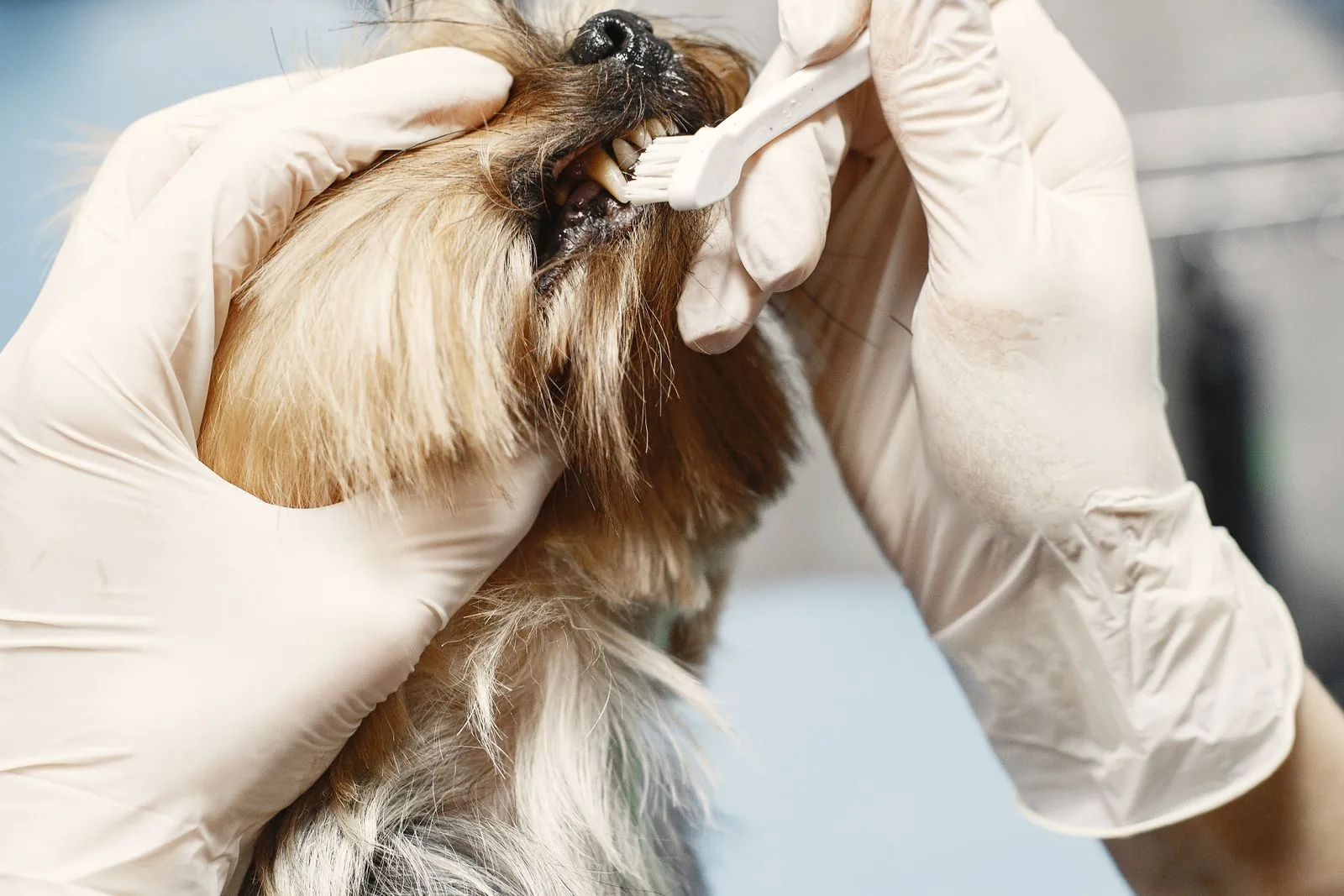
What is actually going on in there
The sequence is the same in every mouth, yours included. Bacteria form a soft film on the tooth surface within hours of it being cleaned. That film matures into a structured biofilm, and minerals from saliva harden it into calculus, the beige-brown material you can see. Calculus itself is not the disease; it is a rough scaffold that lets more biofilm attach where a tongue and a chew cannot reach.
The immune response to that biofilm at the gum margin is gingivitis: red, slightly swollen gum that bleeds easily. Gingivitis is reversible. If it is left, the inflammation moves below the gumline and starts destroying the attachment between tooth and bone. That is periodontitis, and it is not reversible. Bone that has gone does not come back, and the tooth eventually loosens.
Which is why the interesting action is entirely invisible. A dog can have a mouth full of visible calculus and modest attachment loss, or clean-looking crowns and deep pockets around the roots.
How badly it is underestimated
A 2020 review in the Journal of Small Animal Practice gathered the prevalence literature and put the two figures side by side: primary-care practices, where the assessment is a visual look at a conscious dog, report an average prevalence of 9.3 to 18.2%. Detailed examinations of anaesthetised dogs report 44 to 100%.
Two patterns from the same review are worth knowing, because they run against intuition. Risk rises with age, as expected, but it also rises as bodyweight decreases: small and toy breeds are the worst affected, not the large ones. And the disease has favourite sites, typically starting at the incisors, the upper fourth premolars and the first molars.
If you own a small dog and have never had its mouth examined, assume you are in the 44 to 100% bracket until somebody tells you otherwise.
Bad breath is a clinical sign, not a personality trait
Owners consistently underestimate this problem for a simple reason: dogs do not stop eating. A dog with significant periodontal disease will usually keep clearing its bowl, because the drive to eat comfortably outlasts the discomfort of eating. Absence of complaint is not absence of disease.
What to look for instead: breath that has become genuinely unpleasant rather than merely doggy, a red line along the gum margin where it meets the tooth, chewing on one side, dropping food, pawing at the face, blood on a chew toy, or a facial swelling below the eye. That last one is often a root abscess and it is an appointment, not an observation.
Does it matter beyond the mouth?
Probably, and here the honest answer is more interesting than either of the usual ones.
The largest study of the question compared 59,296 dogs with a history of periodontal disease against 59,296 age-matched dogs without one. It found a significant association between the stage of periodontal disease and the later risk of cardiovascular conditions including endocarditis and cardiomyopathy. The detail that makes it more than a curiosity: no comparable association appeared for a range of common non-cardiovascular conditions. A bias that inflated everything would have inflated those too.
But it remains an observational study, and it cannot rule out that dogs whose owners neglect their teeth differ in other ways from dogs whose owners do not. It establishes an association. It does not establish that brushing your dog's teeth protects its heart, and anybody selling you something on that basis is ahead of the data.
The case for dealing with dental disease does not need the heart argument anyway. Painful mouths are reason enough.
What actually works: brushing, at a frequency most people will not like
The evidence here is unusually clean, because someone ran the obvious experiment. A randomised, controlled, blinded study compared four brushing frequencies against no brushing at all, using a defined technique and a standard diet: daily, every other day, weekly and every other week.
More frequent was better across plaque, calculus and existing gingivitis, and the useful finding is where the line falls. Daily and every-other-day brushing produced significantly better results than weekly or fortnightly brushing, and the authors recommended daily. Weekly brushing is not a reduced-strength version of daily brushing; on these measures it barely registers.
That is inconvenient, and I would rather tell you than let you feel virtuous about a Sunday routine that is not doing much. Some practical notes from having taught a lot of owners to do this:
- Dog toothpaste only. Human toothpaste is swallowed rather than spat, and may contain fluoride or xylitol, the latter being seriously toxic to dogs.
- Outer surfaces are where the work is. The tongue does a reasonable job on the inner surfaces. You are after the cheek side of the upper back teeth.
- Build it over weeks, not in one evening. A finger with a little paste on it, then a finger brush, then a soft brush. Ten seconds counts as a win at the start.
- Attach it to an existing habit. The owners who succeed are the ones who do it at the same point in the same routine every day.
What partly works: chews and the rest of the shelf
Chews are the honest second-best, and they earn a place because a chew given daily beats a toothbrush used once a month.
A crossover trial in 17 toy-breed dogs, Yorkshire Terriers and Chihuahuas, gave one dental chew a day and measured against no chew. Gingivitis fell 20%, plaque 15%, calculus 35%, and the volatile sulphur compounds responsible for breath odour 19%. Every one of those was statistically significant.
Read it with its limitations attached: 17 dogs, several of the authors worked for the company that makes the chew, and the effects are reductions in accumulation. A chew slows the process down. It does not remove established calculus or reverse attachment loss, and it will not rescue a mouth that already needs a professional.
Two filters for the aisle. First, look for the Veterinary Oral Health Council seal, which is awarded only to products whose manufacturers have submitted trial data against defined plaque or calculus standards; it does not certify that a product is the best, only that it was tested. Second, remember that a daily chew is daily calories, which quietly works against the other thing your dog's joints need from you, namely staying lean.
Water additives and enzymatic gels sit below chews on evidence rather than on principle. Some have VOHC acceptance; as a category they are the least well supported thing in the oral aisle, and none of them is a substitute for mechanical disruption of the biofilm.
The professional clean, and the thing to refuse
Once periodontitis is established, home care maintains the result of a professional cleaning; it cannot produce one. A proper dental procedure means a general anaesthetic, full-mouth radiographs, probing of every tooth, scaling above and especially below the gumline, and polishing. The radiographs are not an upsell: most of each tooth, and all of the bone loss, is beneath the gum.
Which brings me to the one thing on this page I would ask you to actively refuse. "Anaesthesia-free dental cleaning", offered in some grooming settings, scrapes visible calculus off the crowns of the teeth while the dog is restrained awake. The American Veterinary Dental College, which prefers the term non-professional dental scaling, is explicit that removing plaque and tartar from the outside surfaces of the teeth does not remove plaque and bacteria from beneath the gumline and does not reduce the risk of periodontal disease, and that scaling without proper polishing leaves the surface primed for bacteria to reattach.
So the result is a mouth that looks better to the owner and is no healthier for the dog, at the price of the very thing that would have detected the real disease. If anaesthesia is the worry, and for an older dog it is a reasonable one, the conversation to have is about pre-anaesthetic bloodwork and monitoring, not about avoiding the procedure.
This article is general information, not veterinary advice. Any mouth that is bleeding, swollen or painful, and any dog that has stopped eating comfortably, needs to be examined rather than managed at home.
Wallis C., Holcombe L.J., A review of the frequency and impact of periodontal disease in dogs, Journal of Small Animal Practice 2020;61(9):529–540.
doi.org/10.1111/jsap.13218
Glickman L.T. et al., Evaluation of the risk of endocarditis and other cardiovascular events on the basis of the severity of periodontal disease in dogs, Journal of the American Veterinary Medical Association 2009;234(4):486–494. (59,296 dogs and matched controls)
doi.org/10.2460/javma.234.4.486
Harvey C., Serfilippi L., Barnvos D., Effect of frequency of brushing teeth on plaque and calculus accumulation, and gingivitis in dogs, Journal of Veterinary Dentistry 2015;32(1):16–21. (randomised, controlled, blinded)
doi.org/10.1177/089875641503200102
Mateo A. et al., Evaluation of efficacy of a dental chew to reduce gingivitis, dental plaque, calculus, and halitosis in toy breed dogs, Journal of Veterinary Dentistry 2020;37(1):22–28. (17 dogs, crossover)
doi.org/10.1177/0898756420926766
American Veterinary Dental College, Companion animal dental scaling without anesthesia (position statement).
avdc.org/PDF/Dental_Scaling_Without_Anesthesia.pdf
Veterinary Oral Health Council, VOHC accepted products for dogs.
vohc.org/accepted-products