
How to tell if your dog is in pain, not just old
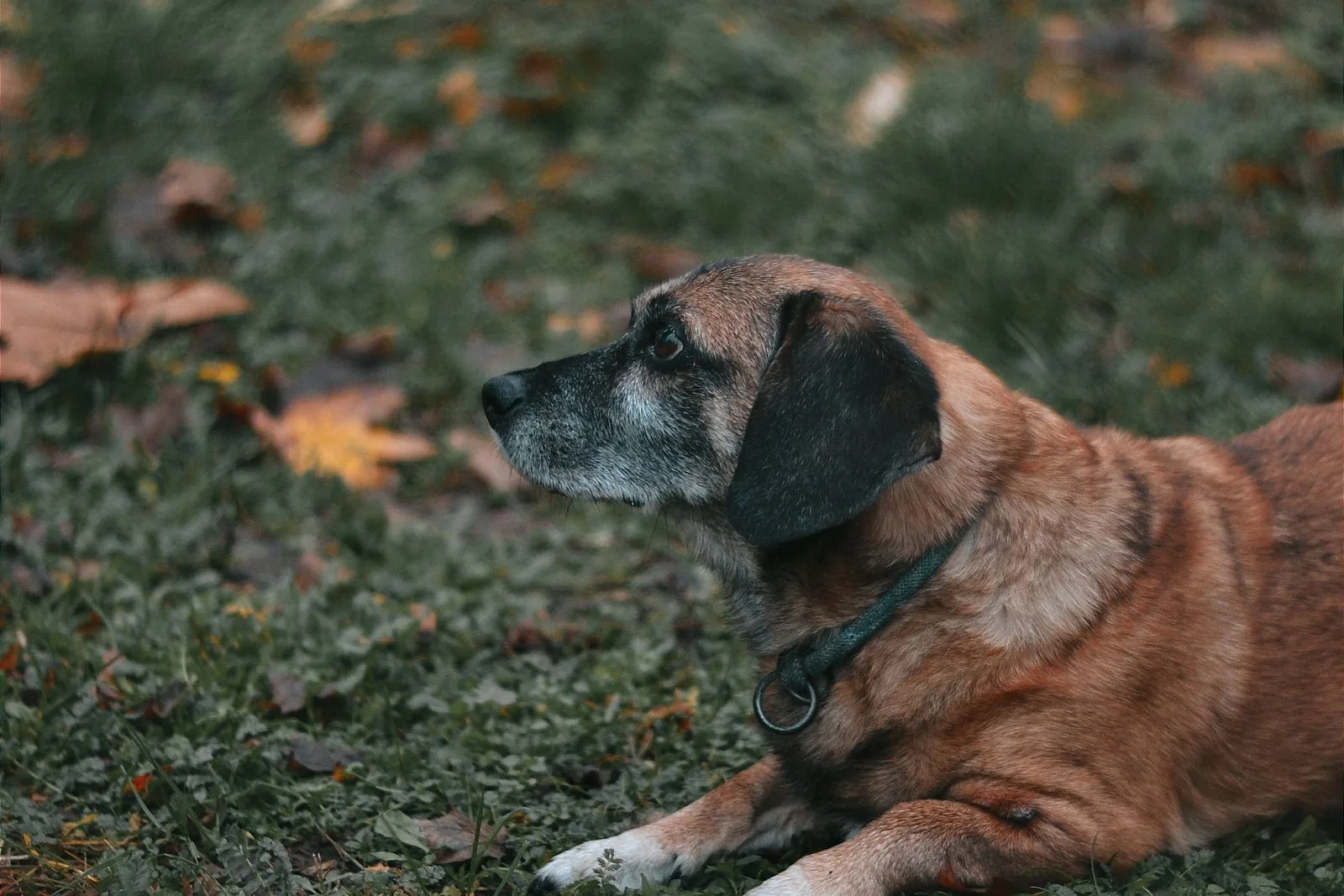
This article helps you describe what you are seeing. It does not replace the appointment where somebody examines your dog. Sudden lameness, one leg much worse than the others, or any change in appetite or behaviour is a same-week veterinary visit, not an observation exercise.
Age is when it shows up, not why
The most useful number I know on this comes from the VetCompass programme, which read the clinical records of 455,557 dogs under primary veterinary care in the UK. Appendicular osteoarthritis, the kind that affects the limbs, had an annual period prevalence of 2.5%, which works out at roughly 200,000 British dogs in a single year. Risk climbed with bodyweight and with age past eight years, and Labradors and Golden Retrievers were among the breeds over-represented.
Then comes the figure that changed how I talk to owners. In dogs that had it, osteoarthritis occupied an estimated 11.4% of their entire lifespan. That is not an end-of-life event. It is a chunk of a dog's life spent in a condition somebody has to notice first.
And 2.5% is certainly an undercount, because it counts dogs whose owners brought them in and whose vets wrote it down. Every dog whose owner concluded "he is just getting old" is missing from that figure.
Why limping is one of the last signs, not the first
Owners look for a limp because a limp is what pain looks like in films. It is a poor early indicator in dogs for two structural reasons.
First, chronic joint disease is frequently symmetrical. Both hips, or both elbows, degrade at a similar rate, so there is no good leg to favour and nothing asymmetrical to see. The dog simply moves less, and moves differently.
Second, dogs are extremely good at redistributing load. They shift weight forwards, shorten their stride, take stairs in a different sequence, and sit down in a way that avoids the sore joint. Every one of those is a compensation, and compensations are invisible unless you know to look for them. By the time an obvious limp appears, the dog has usually run out of ways to hide it.
The signs that actually matter
These are the observations I ask for in the consulting room, roughly in the order owners tend to notice them.
- Hesitation at thresholds. A pause before the stairs, the car boot, or the sofa. The dog still does it, but there is now a moment of calculation first. That moment is the sign.
- Slow to rise, especially when cold. Stiffness that is worst after a long rest and eases with a few minutes of movement is a classic pattern.
- The walk shrinks from the far end. The dog sets off keenly and lags on the way home, or starts turning for home earlier than it used to.
- Changed rest. A new sleeping position, more shifting around before settling, choosing a different surface, or waking in the night.
- Licking one spot. Persistent attention to a specific joint, sometimes with a stained patch of fur over it.
- Handling changes. Grumbling when lifted, flinching when brushed over the hips, or moving away from a hand that used to be welcome. Irritability in an old dog is often a report about pain.
- Social withdrawal. No longer coming to the door, disengaging from play with other dogs, or simply spending more time in another room.
- Posture at toileting. Difficulty holding a squat is easy to miss and hard to explain away.
- Muscle asymmetry. Run both hands down either side of the spine and over the thighs. A limb that is being used less loses muscle, and the difference is often easier to feel than to see.
Turn it into a number, because memory is unreliable
Three owner-completed questionnaires have been formally validated in dogs, and any of them beats trying to remember what last month was like: the Canine Brief Pain Inventory (CBPI), the Liverpool Osteoarthritis in Dogs score (LOAD), and the Helsinki Chronic Pain Index (HCPI). A 2013 study in 222 dogs with osteoarthritis tested all three against force-plate gait analysis, found they agreed with each other, and reported real, if weak, correlations with the objective force data.
They are sensitive enough to matter. In 70 dogs given either carprofen or a placebo for two weeks, the CBPI picked up the difference between the two groups. That is a questionnaire detecting a drug effect, which is a fair test of an instrument.
Here is the wrinkle, and it is an interesting one rather than a damning one. When the same group compared 68 dogs' CBPI changes against their force-plate changes, both measures detected the drug, but they did not correlate with each other at all. The authors' reading was that owners were scoring behaviours other than lameness when they judged whether their dog had improved. Which is to say: the questionnaire and the force plate are both right, and they are measuring different things. Score your own dog against itself over time, and do not try to compare its number with another dog's.
The bias that fools almost everyone, including me
This is the finding I most want owners to know. Researchers took 58 dogs from the placebo arm of a regulated trial, all with lameness from osteoarthritis, and compared what caregivers reported against what a force plate measured.
Owners rated their dog as improved 39.7% of the time. Veterinarians examining the same dogs rated them improved 44.8% of the time at a walk, and 43.1% of the time on joint palpation. The force plates recorded no change at all: 46 of 58 dogs were exactly where they started. The effect grew stronger the longer the study ran.
Nobody in that study was being careless. This is how human observation works when you want an animal to be better. It is also why so many products can collect glowing reviews without ever having done anything, and it is the single strongest argument for writing things down.
So make it concrete before you change anything: pick two or three fixed, binary tests for your dog. Does he get onto the sofa in one attempt, or two? Does he manage the full loop of the park? How long does he take to stand up after his morning sleep? Record the answers, date them, then re-score at four and eight weeks. A note you wrote in March is a better witness than your memory in May.
What to do with the answer
Take it to your veterinarian, ideally with a filled-in questionnaire and a short phone video of your dog rising and walking away from the camera. A dog in an examination room is a dog on adrenaline, and it will often look far better there than it does at home.
Expect the visit to widen the question rather than confirm your theory. Slowing down in an older dog can also come from spinal disease, a soft tissue injury, a neurological problem, endocrine disease, or simply carrying too much weight, and several of those can occur alongside arthritis rather than instead of it. The 2023 international consensus guidelines on canine osteoarthritis now push in exactly this direction: assess dogs proactively at life stages, combining an owner questionnaire with a physical examination and imaging, rather than waiting for an owner to arrive with a limp.
Two things you can start on the day of the appointment, both of which have better evidence behind them than anything in a jar: get the weight down if there is weight to lose, which on its own measurably reduces lameness, and keep the dog moving in short, regular, moderate sessions rather than weekend heroics. Where supplements fit on top of that, and which of them survive a look at their trials, is the subject of our graded joint supplement ranking.
This article is general information, not veterinary advice. The signs described here overlap with several other conditions, and only an examination can tell them apart.
Anderson K.L. et al., Prevalence, duration and risk factors for appendicular osteoarthritis in a UK dog population under primary veterinary care, Scientific Reports 2018;8:5641. (455,557 dogs)
doi.org/10.1038/s41598-018-23940-z
Walton M.B., Cowderoy E., Lascelles D., Innes J.F., Evaluation of construct and criterion validity for the 'Liverpool Osteoarthritis in Dogs' (LOAD) clinical metrology instrument and comparison to two other instruments, PLoS ONE 2013;8(3):e58125. (222 dogs)
doi.org/10.1371/journal.pone.0058125
Brown D.C., Boston R.C., Coyne J.C., Farrar J.T., Ability of the canine brief pain inventory to detect response to treatment in dogs with osteoarthritis, Journal of the American Veterinary Medical Association 2008;233(8):1278–1283. (70 dogs)
doi.org/10.2460/javma.233.8.1278
Brown D.C., Boston R.C., Farrar J.T., Comparison of force plate gait analysis and owner assessment of pain using the Canine Brief Pain Inventory in dogs with osteoarthritis, Journal of Veterinary Internal Medicine 2013;27(1):22–30. (68 dogs)
doi.org/10.1111/jvim.12004
Conzemius M.G., Evans R.B., Caregiver placebo effect for dogs with lameness from osteoarthritis, Journal of the American Veterinary Medical Association 2012;241(10):1314–1319. (58 dogs, placebo arm)
doi.org/10.2460/javma.241.10.1314
Cachon T. et al., COAST Development Group's international consensus guidelines for the treatment of canine osteoarthritis, Frontiers in Veterinary Science 2023;10:1137888.
doi.org/10.3389/fvets.2023.1137888